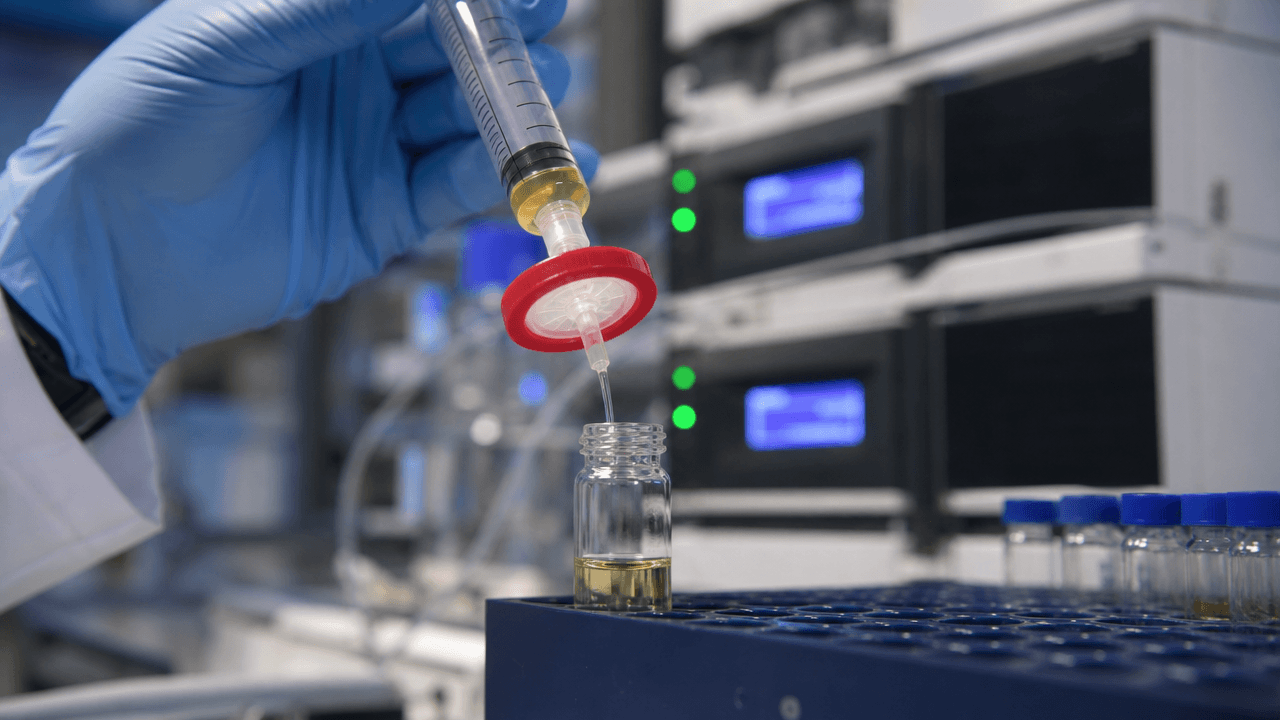
Syringe filters serve as standard consumables for sample preparation in both analytical chemistry and modern biotechnology. The primary objective of sample filtration is the targeted removal of particulate matter and insoluble contaminants prior to injection or downstream processing. This step safeguards sensitive instrumental components, prevents capillary blockages, and preserves data reproducibility. Among the diverse array of microfiltration options, 0.45 µm and 0.22 µm pore sizes represent the industry standards. Selecting the appropriate pore size requires an evaluation of sample matrix properties, stationary phase dimensions, chemical compatibility, and regulatory frameworks.
A standard syringe filter utilizes a polymeric or cellulosic membrane secured within a polypropylene or glass housing. A frequent oversight in laboratory operations is interpreting the designated pore size as a uniform, geometric mesh. In microfiltration physics, pore size ratings define a nominal or maximum cutoff threshold rather than a single fixed diameter.
The manufacturing of polymeric membranes produces an interconnected network of asymmetric tortuous paths. Consequently, a certified 0.22 µm membrane possesses a distribution of pore channels, a percentage of which measure significantly below the 0.22 µm limit. This internal architecture dictates the fluid dynamics, backpressure development, particulate retention capacity, and biomolecule adsorption profiles when processing complex liquid samples.
2. 0.45 µm Syringe Filters: Clarification and Conventional Chromatography
Applications
0.45 µm syringe filters are engineered for general clarification, bulk particle scavenging, and liquid pre-treatment. These membranes target macro-particulates and are applied in several core laboratory procedures:
Downstream Equipment Protection: Positioned as a primary filtration barrier to intercept large suspended solids, thereby protecting ultra-fine downstream filters and high-pressure fluidic lines from premature blinding.
Analytical Solution Clarification: Applied to clear turbid environmental samples, dissolution testing aliquots, and buffer formulations where biological sterility validation is not mandated.
Mobile Phase Pre-Treatment: Utilized to filter HPLC mobile phases, ensuring the removal of dust particles and airborne debris that accelerate pump seal wear and piston degradation.
Chromatographic Hardware Realignment
The implementation of a 0.45 µm cutoff is linked to the physical dimensions of the stationary phase packing material within the analytical system. For conventional High-Performance Liquid Chromatography (HPLC) columns packed with silica or polymer spheres greater than 3 µm in diameter, a 0.45 µm filter provides sufficient retention. It captures debris capable of lodging within the column inlet frit without generating excessive hydraulic resistance during manual sample expression.
Technical Limitations
A 0.45 µm membrane cannot achieve biological sterilization or the complete retention of small bacterial strains. While it retains particles exceeding 0.45 µm, smaller microorganisms—such as Brevundimonas diminuta—readily traverse the tortuous paths. This size limitation makes 0.45 µm filtration unsuitable for assays requiring strict sterile control.
3. 0.22 µm Syringe Filters: Sterilization and Sub-2 µm Separations
Applications
0.22 µm syringe filters are classified as sterilizing-grade filtration components. They are designed to isolate bacterial entities and fine sub-micron particulates from fluid streams, making them essential in high-precision laboratory environments:
Sterile Fluid Preparation: Employed in cell culture and microbiological workflows to sterilize heat-sensitive media, growth supplements, buffers, and reagents in compliance with Good Manufacturing Practice (GMP) and pharmacopoeia standards.
Pharmaceutical Formulation Control: Applied in drug development and compounding to ensure low-volume injectables, ophthalmics, and active pharmaceutical ingredients (APIs) remain free from microbial vectors.
Sub-Micron Analytical Polishing: Utilized in advanced trace analysis where baseline noise from micro-particulates must be minimized.
UHPLC Resolution and System Pressures
The transition from conventional HPLC to Ultra-High Performance Liquid Chromatography (UHPLC) and UPLC systems has reduced system tolerance for particulate matter. Modern UHPLC columns rely on sub-2 µm packing materials, creating narrow interstitial spaces within the column bed. Introducing a sample processed through a 0.45 µm membrane into a sub-2 µm column generates an operational risk of column inlet fouling and rapid system overpressurization. For UHPLC applications, a 0.22 µm syringe filter is required to maintain system uptime and peak symmetry.
Technical Limitations
The fine pore architecture of a 0.22 µm membrane presents clear operational trade-offs. Processing high-turbidity matrices through a 0.22 µm filter without a coarser prefiltration step triggers instantaneous surface blinding, prolonged processing times, and increased consumable expenditure.
4. Bioprocess Mechanics: Viral Vector Filtration Case Study
The functional difference between 0.45 µm and 0.22 µm boundaries is illustrated during the harvesting and clarification of viral vectors, such as lentiviruses, in downstream bioprocessing. Lentiviral vectors exhibit a structural diameter ranging between 80 nm and 100 nm (0.08 µm to 0.1 µm). Based solely on dimensions, these viral spheres are small enough to pass through a nominal 0.22 µm pore network.
However, processing data indicates a technical conflict between biological retention and throughput:
The Mechanism of Titer Loss via Clogging: Standard lentivirus harvesting protocols specify a 0.45 µm filter rather than a 0.22 µm option. Because crude viral harvests contain a dense suspension of cell debris from host packaging lines, a 0.22 µm pore network undergoes immediate surface clogging. Because the 0.22 µm designation represents the maximum pore boundary, the tighter paths within the depth of the membrane physically trap the viral particles. If an incorrect polymer matrix is deployed, this leads to a significant loss of active viral titer, often ranging from 60% to 90%.
Sterilization vs. Clarification Efficiency: A 0.45 µm membrane functions as a clarification step to clear host cell fragments, but it does not establish biological sterility. For downstream clinical applications or large-scale pooled genomic libraries where bacterial contamination must be completely avoided, a 0.22 µm membrane is required. To achieve this without reducing viral yield, the system must utilize specific low-protein-binding polymeric materials.
5. Polymeric Membrane Chemistries and Solvent Compatibility
Pore size selection must be paired with an assessment of the underlying membrane polymer chemistry. Polymers interact with analytes, matrix matrices, and organic solvents through adsorption, swelling, dissolution, or chemical leaching.
Polyethersulfone (PES)
PES membranes feature a highly asymmetric pore structure that delivers high flow rates and low hydraulic resistance. PES exhibits low non-specific protein binding kinetics, making it a suitable choice for processing biopharmaceuticals, serum-supplemented media, and viral vector solutions. When an application requires a sterile 0.22 µm boundary for protein-rich matrices, a PES syringe filter provides optimal microbial retention alongside high target biomolecule recovery.
Polyvinylidene Fluoride (PVDF)
PVDF membranes demonstrate mechanical stability, tensile integrity, and chemical resistance across a broad pH range. Hydrophilic-modified PVDF membranes display low non-specific protein adsorption. This makes them suitable for assays with low protein or serum concentrations, where analyte loss onto the internal filter structure would alter downstream analytical quantification. For workflows combining solvent resistance with sample clarification, the hydrophilic PVDF 0.45 µm syringe filter yields highly reproducible verification metrics across aqueous and mild organic liquid matrices.
Nylon
Nylon is a naturally hydrophilic polymer with broad resistance to organic solvents, alcohols, esters, and alkaline solutions. However, Nylon possesses a high non-specific adsorption capacity for proteins and nucleic acids. While this renders Nylon suitable for conventional small-molecule HPLC sample preparation and mobile phase filtration where proteins are absent, it is unsuitable for biological samples or viral vector purifications where target proteins would be lost to surface adsorption.
Polytetrafluoroethylene (PTFE)
PTFE is a chemically inert polymer that is resistant to strong mineral acids, corrosive bases, aggressive organic solvents, and oxidizers. Hydrophobic PTFE membranes function as effective moisture barriers for gas venting and air filtration. Hydrophilic-modified PTFE membranes are used for general sample pre-treatment in analytical chemistry. When interfacing with aggressive mobile phases or complex matrices under high UHPLC system pressures, the hydrophilic PTFE 0.22 µm syringe filter withstands these experimental parameters without leaching trace impurities into the analytical stream.
Mixed Cellulose Ester (MCE) and Nitrocellulose Warning
MCE membranes, composed of cellulose nitrate and cellulose acetate blends, are standard options for environmental monitoring, aqueous particle profiling, and routine water assays. However, a critical biological limitation must be noted: nitrocellulose-based matrices bind surface proteins on biological viral envelopes. In virology applications, running a viral preparation through an unoptimized MCE or nitrocellulose membrane can disrupt viral structures and deplete functional vectors from the fluid stream, making PES or PVDF alternatives necessary.
6. Engineering Parameters: Effective Filtration Area (EFA) and Lifespan
Beyond pore size metrics and polymer selection, the mechanical dimensions of the filter housing determine operational efficiency. Suspended solids gradually blind open pore channels, reducing fluid flow over time. Highly turbid matrices will block a filter membrane prematurely if the filtration surface area is too small for the sample volume.
To mitigate this behavior, selecting a component with a larger Effective Filtration Area (EFA) extends the operational lifespan of the filter assembly. The selection between a compact 13mm syringe filter and a larger 25mm or 30mm configuration depends on the total sample volume and particulate density:
Low Process Volumes (<10 mL): A small diameter housing (such as 13mm) minimizes hold-up volume (the residual dead-volume trapped within the housing channels). This prevents the loss of expensive or low-volume analytes.
High-Volume or Turbid Matrices (10–100 mL): A wider diameter housing (such as 25mm or 30mm) distributes the incoming particulate load across a larger surface area. This configuration manages rapid pressure increases and prevents premature structural failure of the internal membrane.
7. Operational Comparison Matrix
The table below summarizes the technical and functional differences between the two primary pore size classifications:
Higher fluid resistance, rapid pressure development
8. Systematic Filter Selection Protocol
To optimize sample preparation workflows and ensure data reproducibility, laboratory personnel can follow this structured selection protocol:
Determine the Sterility Requirement: If the protocol requires complete microbial clearance to comply with aseptic guidelines (such as FDA or GMP standards), select a 0.22 µm syringe filter. For non-sterile clarification or bulk particle removal, a 0.45 µm configuration is sufficient.
Evaluate Downstream Instrumentation Constraints: Assess the specifications of the analytical hardware. Conventional HPLC systems packed with >3 µm particles operate reliably with a 0.45 µm cutoff. For ultra-pressurized UHPLC configurations utilizing sub-2 µm columns, a 0.22 µm filter is required.
Analyze Chemical and Macromolecular Interactions: Match the sample components with the appropriate polymer chemistry. For protein-rich matrices or viral vector configurations, avoid high-binding polymers like Nylon or MCE; instead, use low-binding PES or PVDF options.
Perform Empirical Method Validation: If analytical deviations or unexpected analyte losses occur during routine operations, execute a parallel validation study. Process identical fluid batches through different pore boundaries and polymer varieties, then measure downstream recovery rates to establish the optimal configuration for the specific application.
For laboratories focused on consumables cost-control, determining whether a filter matrix can support re-equilibration or cleaning cycles is an ongoing operational consideration. To review an evaluation of contamination limits and organic leaching thresholds, read the technical analysis in Mastering Total Organic Carbon (TOC): A Lab Expert’s Analysis Guide.
Conclusion
The selection between a 0.45 µm and a 0.22 µm syringe filter directly affects sample preparation outcomes, impacting analytical instrument health and bioprocess yield. By systematically evaluating downstream column parameters, the chemical properties of the sample fluid, membrane binding kinetics, and effective filtration area constraints, researchers can safeguard analytical hardware while maintaining target analyte recovery.
Technical Literature References
International Organization for Standardization. ISO 11137: Sterilization of health care products - Radiation.
U.S. Food and Drug Administration (FDA). Guidance for Industry: Sterile Drug Products Produced by Aseptic Processing — Current Good Manufacturing Practice.
Journal of Chromatographic Science. Evaluation of Membrane Filter Compatibility in High-Performance Liquid Chromatography Sample Preparation.

 English
 Chinese

.png)