Jul. 10th, 2026
HPLC and LC-MS both separate compounds by liquid chromatography, but they identify what comes off the column in completely different ways. One detects by light absorption. The other detects by molecular mass. This difference determines whether you detect co-eluting impurities or miss them entirely.
If your lab is deciding between these two technologies, the choice comes down to one question: how much detail do you really need to see? This guide breaks down five critical factors, from sensitivity thresholds to the hidden costs of consumables, to help you pick the right system for your application.
1. The Core Difference: How They See Molecules
In short, HPLC identifies compounds by light absorbance, while LC-MS identifies them by molecular weight.
HPLC relies on UV-Vis or PDA (photodiode array) detectors. Think of this as identifying someone by the color of their shirt. If two different compounds elute at the same time and share the same UV absorbance spectrum, HPLC cannot tell them apart. This is called co-elution. It is a fundamental limitation of optical detection.
LC-MS adds a mass spectrometer to eliminate this blind spot. It identifies compounds by their mass-to-charge ratio (m/z) . Even if two peaks overlap completely on a chromatogram, the MS separates them based on their specific m/z values. Co-elution becomes irrelevant.
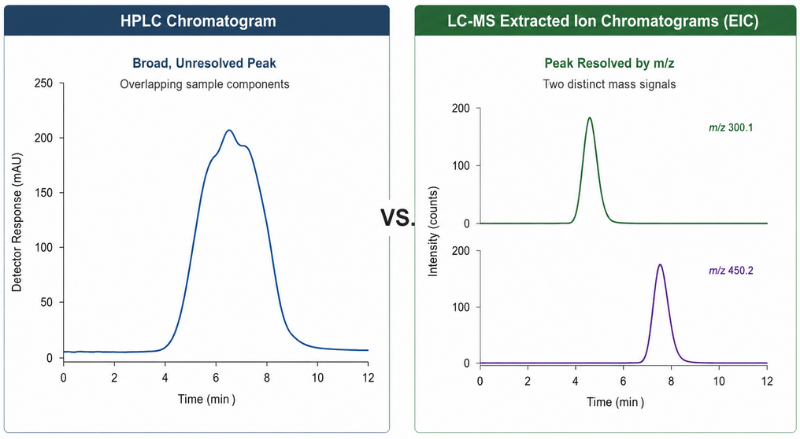
2. Data Comparison: HPLC vs LC-MS/MS at a Glance
Your target detection limit dictates your budget level.
As you move from HPLC to triple quadrupole LC-MS/MS, sensitivity jumps from parts per million (ppm) to parts per trillion (ppt). However, this increase in sensitivity comes with exponentially stricter sample cleanliness requirements.
| Metrics & Features |
HPLC (UV-Vis / PDA) |
LC-MS (Single Quad) |
LC-MS/MS (Triple Quad) |
| Detection Principle |
Light Absorption |
Molecular Weight (m/z) |
Mass Fragments (Product Ions) |
| Sensitivity Threshold |
ppm (parts-per-million) |
ppb (parts-per-billion) |
ppt (parts-per-trillion) |
| Selectivity |
Moderate (Co-elution risk) |
High |
Extremely High (Highly Specific) |
| Sample Prep Requirement |
Standard (0.45 micron filter) |
Ultra-clean (0.22 micron filter) |
Certified Low-Background Consumables |
| Consumables Cost Tier |
Budget-friendly |
Premium |
Enterprise-Grade / Certified |
| Primary Applications |
Routine QA/QC, Assay Testing |
Unknown Identification |
Trace Impurities, Bioavailability |
3. Sensitivity: High Concentration vs Trace Detection
Use HPLC for high-concentration stability. Use LC-MS/MS for trace-level detection.
HPLC maintains excellent relative standard deviation (RSD under 0.5%) for standard assays, making it easy to validate for routine QA/QC and regulatory filings. If your samples are clean and concentrations are high, HPLC is a reliable, low-maintenance workhorse.
LC-MS/MS becomes necessary when you are extracting nanogram-level targets from complex matrices like blood plasma, soil extracts, or food samples. When your detection limit drops to ppb or ppt, the sensitivity of a UV detector is simply not enough.
When to stick with HPLC:
-
Routine QA/QC of pharmaceutical actives
-
High-concentration samples in simple matrices
-
Established methods with regulatory approval
When you need LC-MS/MS:
-
Trace impurities, pesticide residues, or mycotoxins
-
Metabolite identification in biological fluids
-
Forensic toxicology or environmental monitoring
-
Unknown compound identification
HPLC tells you a peak is there. LC-MS tells you exactly what that peak is. If your work involves identifying unknown contaminants at the ppb level, mass spectrometry is the only practical path.
4. Can Standard HPLC Columns Be Used on an LC-MS System?
Do standard liquid chromatography columns work on mass specs?
In summary, yes, but with severe operational caveats. The takeaway is that standard HPLC columns often experience stationary phase bleeding, which translates directly into massive background noise on sensitive mass spectrometers.
While a UV detector is blind to minor column bleed, a mass spectrometer ionizes everything entering the source, including chemical fragments shedding from the stationary phase. This bleeding raises your baseline noise, degrades the signal-to-noise ratio, and introduces ghost peaks that can ruin trace quantification data.
5. Why Your LC-MS Ghost Peaks and Ion Suppression stem from Consumables
Based on lab troubleshooting records, most LC-MS problems ultimately trace back to consumables: vials, caps, or syringe filters of insufficient quality. While HPLC is highly forgiving of minor plasticizers or glass impurities, LC-MS is prone to ion suppression, where invisible chemical contaminants mask your target analytes
The Glass Vial Factor: Type 5.0 vs. Type 7.0 Glass
Cheap glass autosampler vials leach alkali metal ions (such as Na+ and K+) into the mobile phase, particularly when running acidic sample matrices. These free ions form [M+Na]+ or [M+K]+ adducts during electrospray ionization (ESI). This splits your mass signal, lowers sensitivity, and generates unpredictable ghost peaks.
We highly recommend using certified, low-background Type 5.0 ND9 glass vials combined with 9mm bonded caps. Type 5.0 borosilicate glass features a significantly lower metal ion leaching rate than standard Type 7.0 glass, while bonded septa eliminate the risk of adhesive outgassing and septa displacement.
The Filtration Rule: Why 0.22 Micron is Mandatory
To safeguard sensitive ESI needles (which typically feature an internal diameter of just 10 to 20 microns), the old 0.45 micron filtration standard is obsolete for modern LC-MS. Sub-micron particulates that pass through a 0.45 micron membrane will clog ESI capillaries over time, causing pressure spikes and costly instrument downtime.
Always use certified, low-extractable 0.22 micron syringe filters. Standard HPLC filters often leach oligomers and manufacturing residues directly into your sample, creating a forest of unwanted mass peaks across your spectra.
Mobile Phase Volatility Constraints
LC-MS demands exclusively volatile mobile phase modifiers, such as ammonium acetate, ammonium formate, or formic acid. Non-volatile salts like sodium phosphate will precipitate instantly within the mass spectrometer ion source, permanently fouling the vacuum interface and requiring intensive system teardowns.
6. Cost and Complexity Trade-offs
Match your technology to your regulatory environment and analytical depth.
| Cost & Operational Dimensions |
HPLC Systems |
LC-MS/MS Systems |
| Capital Investment |
Low to moderate entry barrier |
High capital expenditure |
| Operating Costs |
Low (Standard HPLC grade solvents) |
High (Ultra-pure LC-MS grade solvents) |
| Maintenance Depth |
Routine lamp and pump seal replacement |
Complex ion source cleaning, vacuum pump service |
| Consumables Profile |
Standard vials and 0.45 micron filters |
Certified low-background vials and 0.22 micron filters |
If your lab does routine QC/QA with established protocols, HPLC is your clear economic winner. If your scope involves R&D, unknown structural elucidation, or trace level analysis at ppb/ppt levels, LC-MS/MS is your only viable technical pathway.
Struggling with unexplained baseline noise or sudden ion suppression? Dont let low-grade consumables compromise the data precision of a high-end mass spectrometer. Contact our lab application specialists directly via WhatsApp: +86 18338832256 or email boonemi@aijirenvial.com to request a complimentary evaluation kit of LC-MS certified vials and filters tailored to your analytical methods.
7. Quick Selection: Which System Fits Your Lab?
| Primary Lab Workload |
Recommended System |
Essential Consumables Specification |
| Routine QA/QC, high-concentration API testing |
HPLC |
Standard 0.45 micron filters, Type 7.0 or Type 5.0 vials |
| Unknown peak identification, structural checking |
LC-MS (Single Quad) |
0.22 micron filters + low-bleed columns + Type 5.0 vials |
| Trace impurities, pesticide residues, environmental toxins |
LC-MS/MS (Triple Quad) |
Certified Type 5.0 vials + 0.22 micron low-extractable filters + Bonded caps |
| Bioavailability, clinical metabolites, forensic toxicology |
LC-MS/MS |
LC-MS certified vials + Bonded septa caps + 0.22 micron certified filters |
Frequently Asked Questions
Q1: Can I use standard HPLC vials for high-sensitivity LC-MS/MS workflows?
Technically, the autosampler will physically accept them, but you will likely experience elevated baseline noise and unexplained ghost peaks. For trace analysis (ppb or ppt levels), utilizing certified, low-background Type 5.0 vials is the most cost-effective insurance policy for protecting your data integrity.
Q2: Why is the use of volatile buffer salts absolute for LC-MS?
Non-volatile salts like sodium phosphate do not vaporize in the ionization source. They precipitate as solid crusts, permanently blocking the mass spectrometer vacuum cone and ion optics. Stick strictly to ammonium acetate, ammonium formate, or dilute formic acid. If an older HPLC method uses phosphate buffers, it must be completely redeveloped before injection into an LC-MS.
Q3: Should my LC-MS autosampler run crimp neck vials or screw thread vials?
Screw caps offer high throughput and convenience for day-to-day operations. Crimp top vials provide the absolute best hermetic seal for highly volatile analytes or extended injection sequences (such as overnight or weekend runs). For the majority of high-throughput LC-MS applications, an advanced screw vial equipped with a high-quality bonded cap performs flawlessly.
Q4: Why does my LC-MS mass spectra show a dominant sodium adduct [M+Na]+ peak?
Sodium adducts are almost always caused by sodium ions leaching from low-grade glass autosampler vials or improper sample handling. Standard Type 7.0 borosilicate glass sheds significantly more sodium ions than high-purity Type 5.0 glass, especially when exposed to acidic mobile phases. If [M+Na]+ ions dominate your spectra over the expected [M+H]+ ions, replace your vials with certified Type 5.0 glass immediately.
Q5: How can I verify if a batch of vials is genuinely "LC-MS Grade"?
Always check the batch-specific Certificate of Analysis (COA). A true LC-MS grade vial COA must display an actual LC-MS blank chromatogram test. It should certify that across a mass scan range of 100 to 1000 m/z, no extractable chemical peaks appear above the baseline noise floor, alongside strict limits on alkali metal leaching.
Q6: What happens if I accidentally use a 0.45 micron filter instead of a 0.22 micron filter for LC-MS?
An electrospray ionization (ESI) capillary needle has an internal diameter of only 10 to 20 microns. Fine sub-micron particulates that easily clear a 0.45 micron membrane will aggregate inside the ESI capillary over time. This causes progressive clogging, erratic system pressure, spray instability, and expensive hardware repairs. Furthermore, uncertified 0.45 micron HPLC filters often leach polymers directly into the sample matrix.
Q7: Can I wash and reuse LC-MS glass autosampler vials to save costs?
We strongly advise against this. Once an autosampler needle punctures a septum, micro-fragments of plastic/rubber drop into the vial. Furthermore, chemical residues bind tightly to the inner glass surface, introducing severe cross-contamination risks. Washing can also create microscopic scratches on the inner glass walls, which permanently adsorb polar analytes and cause erratic recovery rates in subsequent runs.
Q8: What causes my LC-MS baseline to drift upward consistently during a gradient run?
An upward baseline drift is typically caused by column bleed as the organic solvent ratio increases during the gradient, or by the slow accumulation of trace impurities from your mobile phase buffers on the ion source. Verify that your column is rated for low bleed, ensure your mobile phase modifiers are strictly LC-MS grade, and confirm your buffers have been filtered through a clean 0.22 micron membrane.
Q9: How should I store prepared samples inside LC-MS vials for long-term stability?
For short-term holds (a few hours up to overnight), the temperature-controlled environment of your autosampler tray is sufficient. For long-term archiving, use certified Type 5.0 vials fitted with bonded caps to prevent evaporation. If stability data allows, store them at -20 or -80 degrees Celsius. Always ensure aqueous samples are completely thawed and vortexed thoroughly before injection to remix any components that precipitated during freezing.
Q10: What is the single biggest mistake labs make when upgrading from HPLC to LC-MS?
Assuming that everything that works for an HPLC assay is safe for a mass spectrometer. The most frequent errors include continuing the use of non-volatile phosphate buffers, using standard Type 7.0 glass vials that leach metals and plasticizers, filtering samples with standard 0.45 micron membranes, and neglecting to buy certified LC-MS grade solvents.
To avoid these errors, always run a blank solvent injection at the start of every sequence to establish a clear background profile for your instrument system.
Partner with Our Laboratory Consumables Experts
Zhejiang Aijiren Technology Co., Ltd. brings over 15 years of specialized R&D and precision manufacturing experience to the global chromatography consumables market. Our portfolio of LC-MS Certified Type 5.0 Vials, Bonded Septa Caps, and Ultra-Low Extractable 0.22 micron Syringe Filters is engineered specifically to stabilize LC-MS/MS baselines and eliminate consumable-induced errors.
For application-specific recommendations, bulk procurement pricing, or custom OEM configurations, reach out to our global technical support team today:

 English
 Chinese