Pesticide Residue Testing: Why PES Syringe Filters are Critical for Food Safety
Knowledge
categories
INQUERY

Optimizing Pesticide Residue Testing: What I’ve Learned About Sample Prep and Filters

Feb. 3rd, 2026

If you’ve ever spent a Friday afternoon staring at a chromatogram full of ghost peaks when you should have been heading home, you know exactly why I’m writing this. In our lab, we used to think the mass spec was acting up, or maybe the column was dead. But nine times out of ten, the culprit wasn't the machine—it was the sample prep .

Specifically in testing for pesticides, we are dealing with increasingly complex matrices. I remember trying to analyze strawberries last season; the pigment load alone was enough to ruin our liners within a week. That’s when we realized: if we don’t clean up the sample physically before it hits the instrument, we are just burning money. Whether you are running standard HPLC or deciding which chromatography method to choose , the cleanliness of your sample is the only thing standing between you and a reliable result.


Real-World Challenges in Testing for Pesticides

We mostly rely on QuEChERS because it's fast. But "catch-all" extraction means you catch the bad stuff too—waxes, lipids, and particulates that are invisible to the naked eye. When we run multi-residue methods, the biggest headache is maintaining consistency. You can have the best SOP in the world, but if your filtration step varies, your retention times drift.

We found that the final push through a syringe filter is the critical checkpoint. If that filter bleeds chemicals or binds your analyte, your data is garbage. For those new to membrane selection, understanding the nuances of 0.22 micron filters is a good place to start, especially when moving from GC-MS to the more sensitive GC-MS/MS setups .


Why I Switched to Polyethersulfone Syringe Filters (PES)


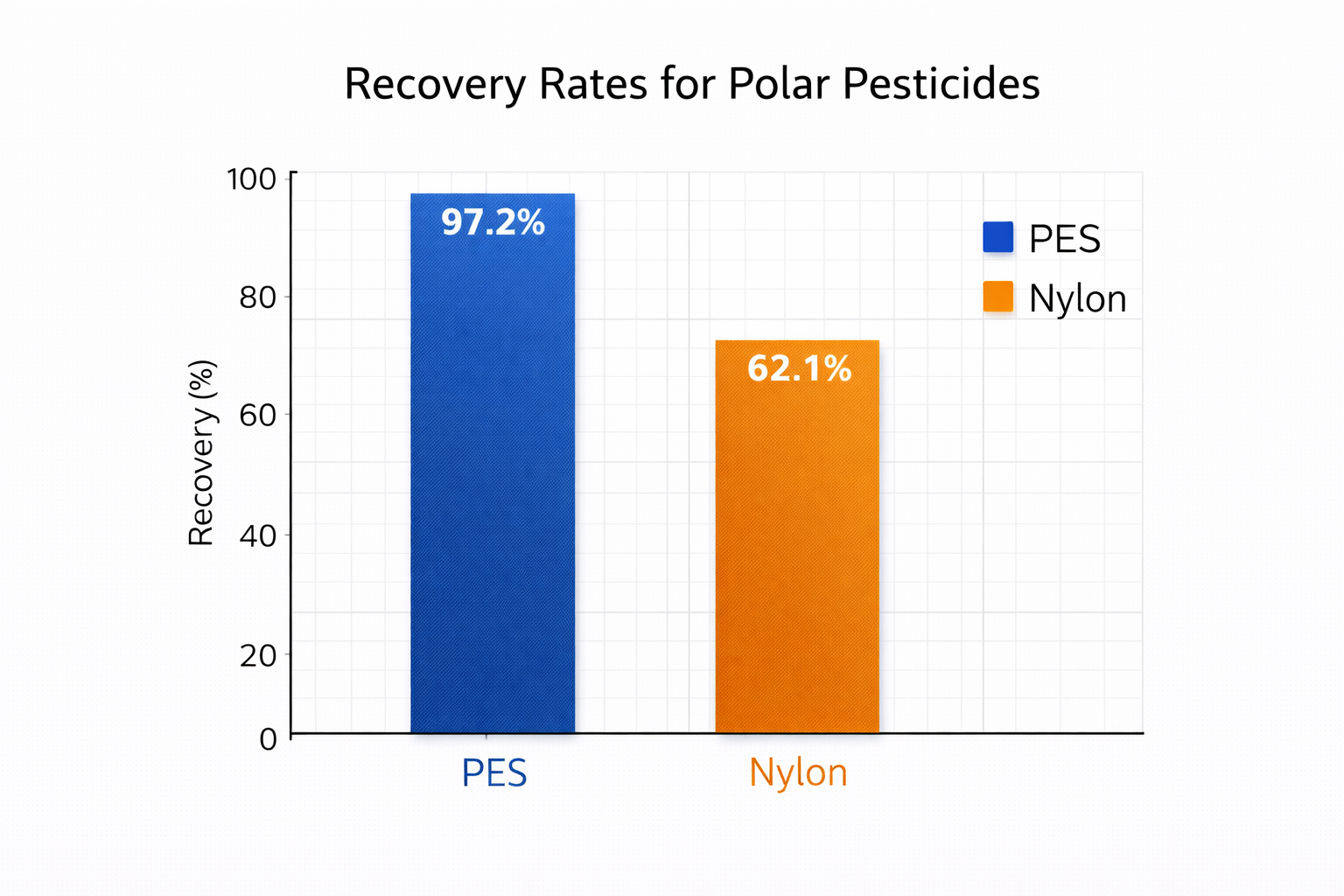
Showing a chart comparing the recovery rates of PES and Nylon membranes when dealing with polar pesticides

For years, I was a creature of habit. I used Nylon filters because... well, that’s just what the supplier sent us. It took a massive failure in a neonicotinoid study for me to realize that Nylon was actually stealing our polar pesticides through hydrogen bonding.

Switching to a polyethersulfone syringe filter was a turning point. If you are struggling with low recovery, look at your membrane. PES is naturally hydrophilic; it doesn't need pre-wetting with alcohols that might interfere with your trace analysis. When compared to 0.45 micron membranes , the 0.22μm PES provides that extra security for your UHPLC columns.

  1. Lower Backpressure: Your thumbs will thank you. PES has a high void volume, meaning you can filter 10ml of sample without feeling like you’re at the gym.

  2. Analyte Recovery: For polar pesticides, we saw recovery rates jump from 78% to 96% just by swapping the filter.

  3. Stability: We don't see the "membrane leaching" peaks that often plague cheaper, uncertified filters.


Protecting Your Autosampler with the Right Vials

It’s not just about the filter; it’s about where the filtered sample goes. I’ve seen people use cheap vials only to have the septa coring and clogging the injection needle. We’ve standardized on 9mm Short Thread Vials with Bonded Septa . The bonded design means the septa can't be pushed into the vial—a small detail that saves you from an "Instrument Error" at 3 AM.

The Environmental Link: COD Chemical Oxygen and Beyond

Pesticide runoff doesn't exist in a vacuum; it’s part of a larger environmental matrix. Many of our clients are tasked with environmental monitoring , which requires measuring cod chemical oxygen (COD) alongside specific toxins.

High organic loads interfere with extraction efficiency. We use cod chemical oxygen tests to gauge how much "junk" we need to clean up before the GC run. For this, the quality of the glass matters immensely. I’ve broken enough cheap tubes in the digester to know that Borosilicate 3.3 is the only way to go.


A Word on Reagent Suppliers and Storage

You can buy the most expensive solvents from top reagent suppliers, but if you store them in a vessel with a poor seal, they will absorb atmospheric water and contaminants. For our high-concentration standards, we rely on 4ml Screw Neck Vials .

If you are running headspace analysis for volatile pesticides, don’t cut corners on the 20mm Crimp Vials or the 18mm Magnetic Caps . A leaky headspace vial is a guaranteed failed batch.


Practical Comparison: Lab User Experience

Troubleshooting Point Aijiren PES Filter + Vials Generic "Budget" Options
Manual Filtration Easy, high flux (less effort) Clogs, requires high hand pressure
Analyte Loss < 2% (Polar compounds) Up to 15% loss on Nylon
Septa Coring Bonded caps prevent coring Septa often drops into the vial
Vial Integrity USP Type 1 Glass Lower grade glass (leaches alkali)

  • The Problem: Inconsistent recovery rates in testing for pesticides caused by membrane adsorption and poor-quality autosampler vials.

  • The Solution: Aijiren’s polyethersulfone syringe filter provides superior recovery for polar analytes, while their 9mm screw vials ensure injection precision.

  • Compliance: Our products are compatible with high-purity solvents from global reagent suppliers and meet rigorous ISO 9001 and USP Type 1 standards.


Let's Fix Your Workflow

I know how much of a hassle it is to change your consumables. You have to validate, run blanks, and convince the lab manager. But if you’re seeing baseline drift or failing your QC checks, the filter or the vial is often the easiest thing to fix.

I’m happy to send you a sample pack of our PES filters and 9mm vials to try on your most difficult matrix.

Connect with us directly for technical support:

Inquiry