2. Beyond the Surface: What is Truly Measured by Blood Alcohol Content?
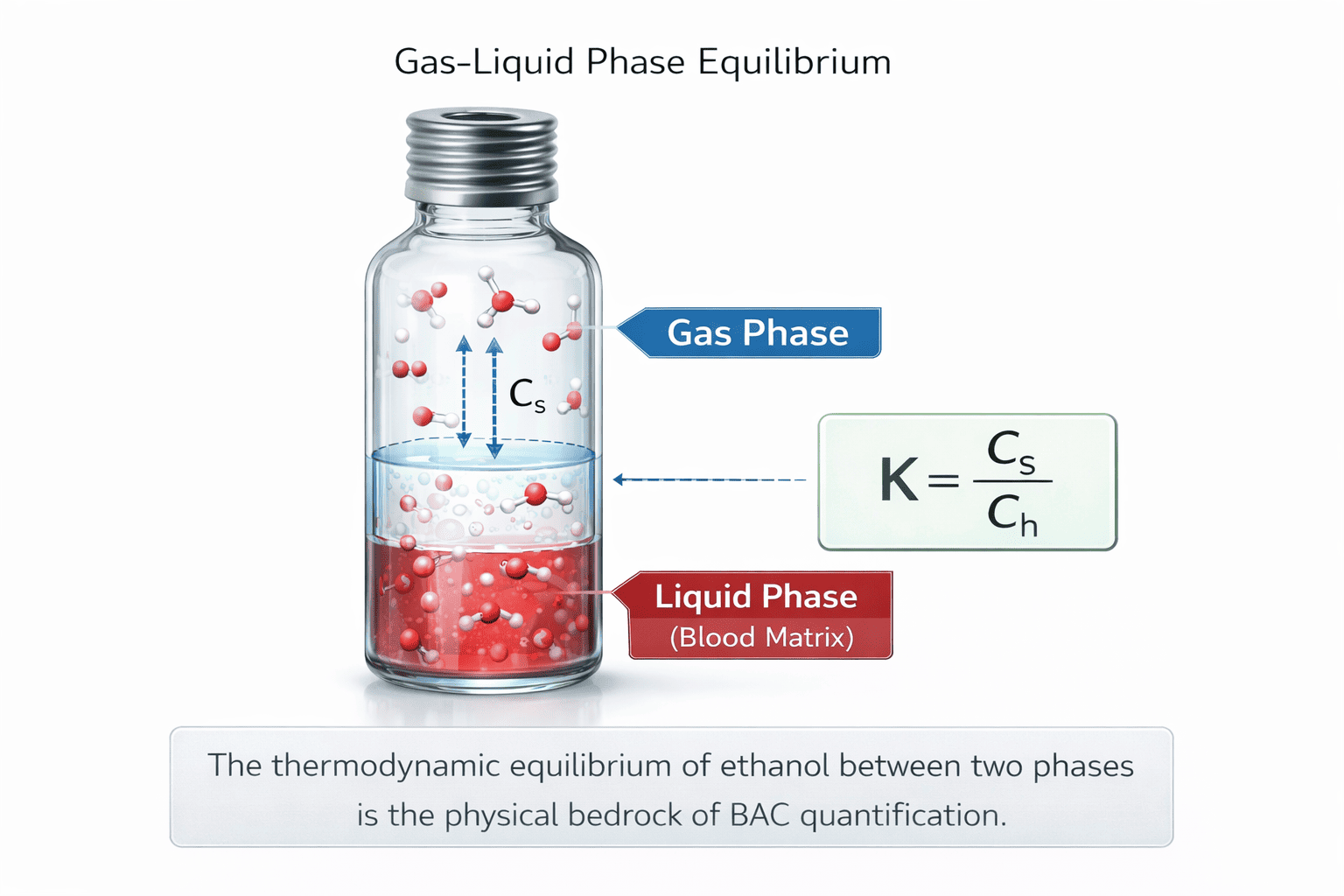
In the professional field, the answer to what is measured by blood alcohol content is a simple mass per volume ratio. However, from a chromatographic perspective, we are actually measuring the gas-liquid partition coefficient, commonly referred to as the K value. When a blood sample is placed in a precision vial, the ethanol molecules distribute themselves between the blood matrix and the headspace above it until they reach a state of thermodynamic equilibrium governed by Henry's Law. This equilibrium is extremely sensitive to temperature and pressure stability.
As a practitioner with decades on the bench, I have learned that the integrity of this measurement is entirely dependent on the stability of this equilibrium. If your vial's internal geometry is inconsistent—a common flaw in low-cost, mass-produced vials—the vapor-to-liquid volume ratio, or the Phase Ratio (Beta), varies from one vial to the next. This causes your K value to drift uncontrollably, leading to high Relative Standard Deviation (RSD) in your final data. This is why we specify Class 1 Borosilicate glass. It is not just about physical strength; it is about the low expansion coefficient and chemical inertness. Cheaper glass often exhibits active silanol groups on the surface that trap ethanol molecules through hydrogen bonding. This adsorption leads to an under-recovery of the analyte, which can be a critical error in forensic science. Furthermore, any thermal gradient across the vial wall will disrupt the molecular kinetic energy, which is why wall thickness uniformity is the silent hero of reproducible chromatography. For more detailed technical specifications on glass inertness, you may refer to the data for
18mm Screw Thread Headspace Vials
which are designed for high-precision thermal equilibrium.
3. The Mechanics of Deception: Why Blood Ethanol Conversion Fails Without Precision Vials
The search for blood ethanol conversion usually stems from a need to equate different matrices, such as converting a hospital’s serum ethanol result to a forensic whole-blood BAC. But here is the expert secret: conversion factors are only mathematically valid if the sample integrity was maintained perfectly during the heating and incubation phase. If the vial is not perfectly sealed, the most volatile components escape first, skewing the ratio.
In my experience, many labs face mystery variances where the conversion math simply does not align with the secondary test results. Nine times out of ten, the culprit is Ethanol Volatility during the incubation period. If you are using an 18mm Screw Neck Vial, the torque applied to the cap must be perfectly uniform to ensure the septa compresses into every microscopic ridge of the glass rim. Many mass-produced vials suffer from "ovalization" of the neck under thermal stress. If the vial neck warps by even a few microns at 70 degrees Celsius, the pressurized ethanol vapor—being a small, agile molecule—will bypass the septum long before the heavier vapors do. You might think you are seeing a biological variation in the conversion rate, but in reality, you are just looking at a leaking vial. To prevent this, for automated labs, we suggest checking the compatibility of these
18mm Magnetic Screw Caps
as they provide the most consistent sealing force in high-throughput environments.
4. Mastering the How: The Kinetic Requirements of Accurate BAC Analysis
When analyzing how to measure alcohol content in blood, the focus is usually on the GC-FID detector settings. But the real technical challenge happens in the 30 minutes of equilibration before the injection occurs. To achieve a "Legal BAC" result, the sample is often salted out to decrease ethanol solubility, which creates an internal "pressure cooker" environment inside the vial.
If your GC Septa is too soft, it will bulge outward under this internal pressure, effectively increasing the headspace volume and altering the concentration calculation. Conversely, if the material is too hard, the autosampler needle will "core" the septum, pushing a plug of silicone into the vial or, worse, into your expensive capillary column. Aijiren PTFE/Silicone septa undergo rigorous Shore A Hardness testing to find the optimal range for both resealability and resistance. The PTFE layer acts as a total chemical barrier, ensuring that the aggressive salt-saturated blood matrix does not react with the silicone elastomer core. This level of detail is what separates a standard test from a forensic-grade analysis. If you want to know how to measure alcohol content in blood with zero doubt, you must ensure your vials can handle internal pressures exceeding 30 psi. In many high-pressure methods, experts recommend using
20mm Crimp Top Headspace Vials
for their superior mechanical grip and seal integrity.
5. Field Forensics: Investigating the Chemical Shadows in the Blood Alcohol Level Test Kit
The term blood alcohol level test kit often implies a complete solution, but in the chromatography world, the kit is only as strong as its weakest consumable component. In my years of auditing labs for international accreditation, I have identified several "invisible killers" of accuracy that no software calibration can fix. The most common is "Septum Bleed," where low-quality silicone releases siloxanes at high temperatures, creating ghost peaks that co-elute with the ethanol or the internal standard.
Another critical factor is the introduction of extractables during sample preparation. When prepping blood or urine, researchers often use syringe filters to remove fibrin and particulates. If the filter housing is not made of medical-grade, virgin polypropylene, you are introducing plasticizers that can haunt your FID detector for weeks. For high-purity sample cleanup, practitioners often choose these
Universal Laboratory Syringe Filters
to ensure that the filtration process adds zero organic load to the sample. Furthermore, the surface energy of the glass matters; if you are not using deactivated, high-purity glass, the "active sites" can cause peak tailing, which makes accurate peak integration nearly impossible. Ensuring that every component in your test kit meets these chemical purity standards is the only way to guarantee the legal defensibility of your results.
6. Efficiency at Scale: Why Modern Labs Standardize on Aijiren
.png)
Whether you are performing a routine DUI check or a complex forensic reconstruction, the workflow remains the same. The reason many of the world's leading labs choose Aijiren is the systematic reduction of variables. When your vial rack fits your vials perfectly, and your crimper is calibrated to the exact hardness of your caps, you eliminate the human factor of error. This standardization is critical for maintaining a low Relative Standard Deviation (RSD) across thousands of samples.
For laboratories that run both HPLC screenings and GC-FID quantifications, standardization across different instrument platforms is the key to operational efficiency. To minimize the risk of autosampler needle strikes and mechanical downtime, we recommend the use of
9mm Short Thread Vials
for their universal fit across all major brands like Agilent, Shimadzu, and Waters. If you are looking for the best way how to measure alcohol content in blood, you are looking for a system where the consumables are invisible—they just work, every time, without fail, allowing the scientist to focus on the data rather than the defects. Standardizing your lab on high-quality consumables is not just a procurement decision; it is a commitment to the scientific integrity of your results.
Experience Forensic Integrity Today
Don’t let a 0.01% deviation compromise your professional reputation. In the world of forensic toxicology, "close enough" is never enough. Aijiren provides the rock-solid foundation your data deserves.

 English
 Chinese

.png)
.png)
-ratio.png)