In my years spent hovering over degassers and troubleshooting baseline drifts, I’ve heard the question a thousand times: "Is it time to ditch my HPLC for a UPLC?" It sounds like a simple choice of "new vs. old," but as any bench scientist knows, the reality is far more nuanced. While HPLC (High-Performance Liquid Chromatography) has been our reliable workhorse for decades, the shift toward UHPLC (Ultra-High-Performance Liquid Chromatography) or UPLC isn't just about speed—it’s about the physics of the separation itself.
By 2026, the demand for "Green Chemistry" and hyper-throughput has made the uplc vs hplc debate central to lab procurement and method development
Side-by-side photo of Agilent 1100 HPLC vs. Waters ACQUITY UPLC
1. The Core Physics: Particles and Pressure
The fundamental difference between hplc vs uplc boils down to the Van Deemter equation. In short: smaller particles yield higher efficiency.
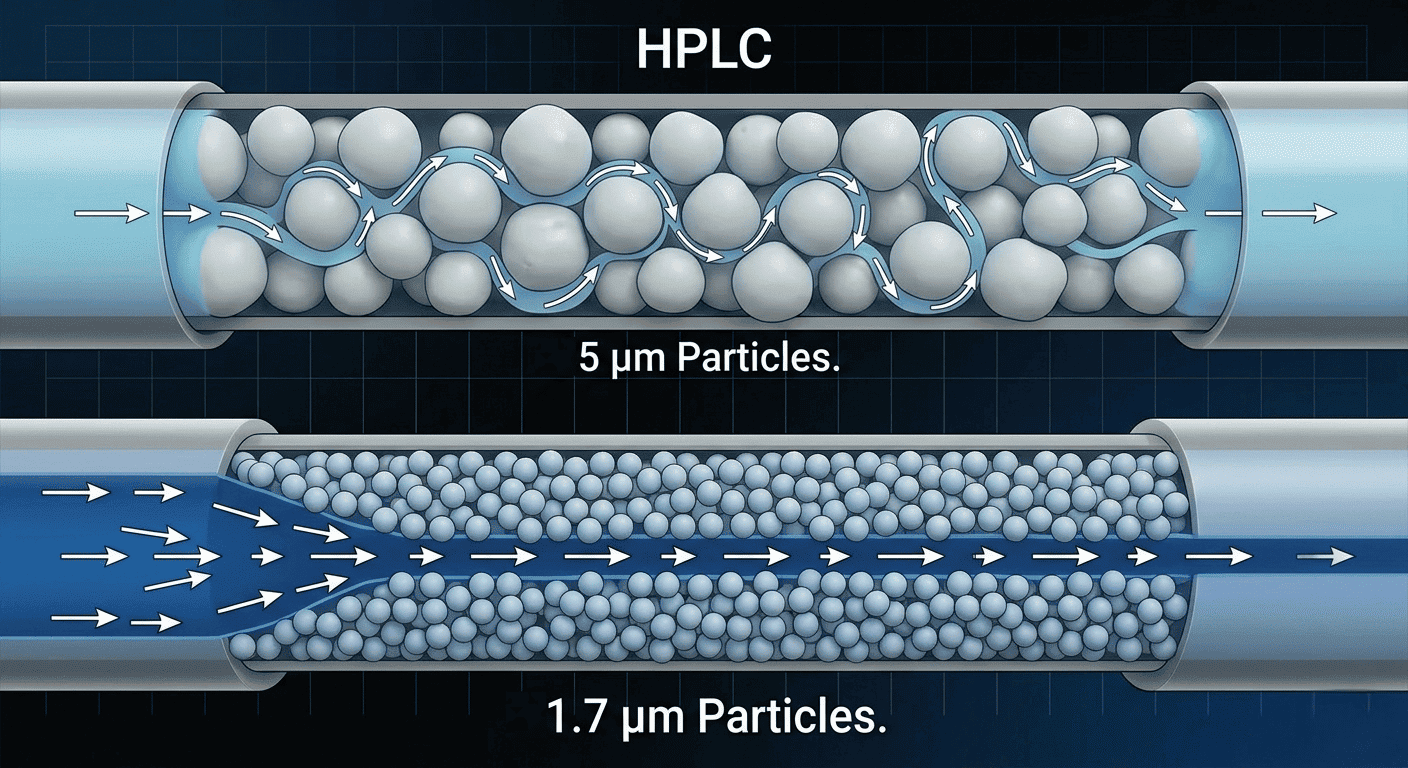
Particle Size: Traditional HPLC columns are packed with 3--5μm particles. UPLC breaks this barrier by using sub-2 um particles (typically 1.7 μm or 1.8μm). These smaller particles significantly reduce the diffusion path, resulting in sharper, narrower peaks.
3D illustration of 5 µm vs. 1.7 µm particle flow paths
Pressure Thresholds: This is the "High Pressure" in the name. While a standard HPLC system might scream at 6,000psi (400bar), a UPLC system is engineered to handle up to 15,000 psi(1,000--1,000bar). This allows us to push mobile phases through those tiny particle gaps without the system failing.
2. Why the Shift? UPLC Advantages Over HPLC
When I talk to lab managers about the uplc advantages over hplc, the conversation usually starts with the clock, but it ends with the bottom line.
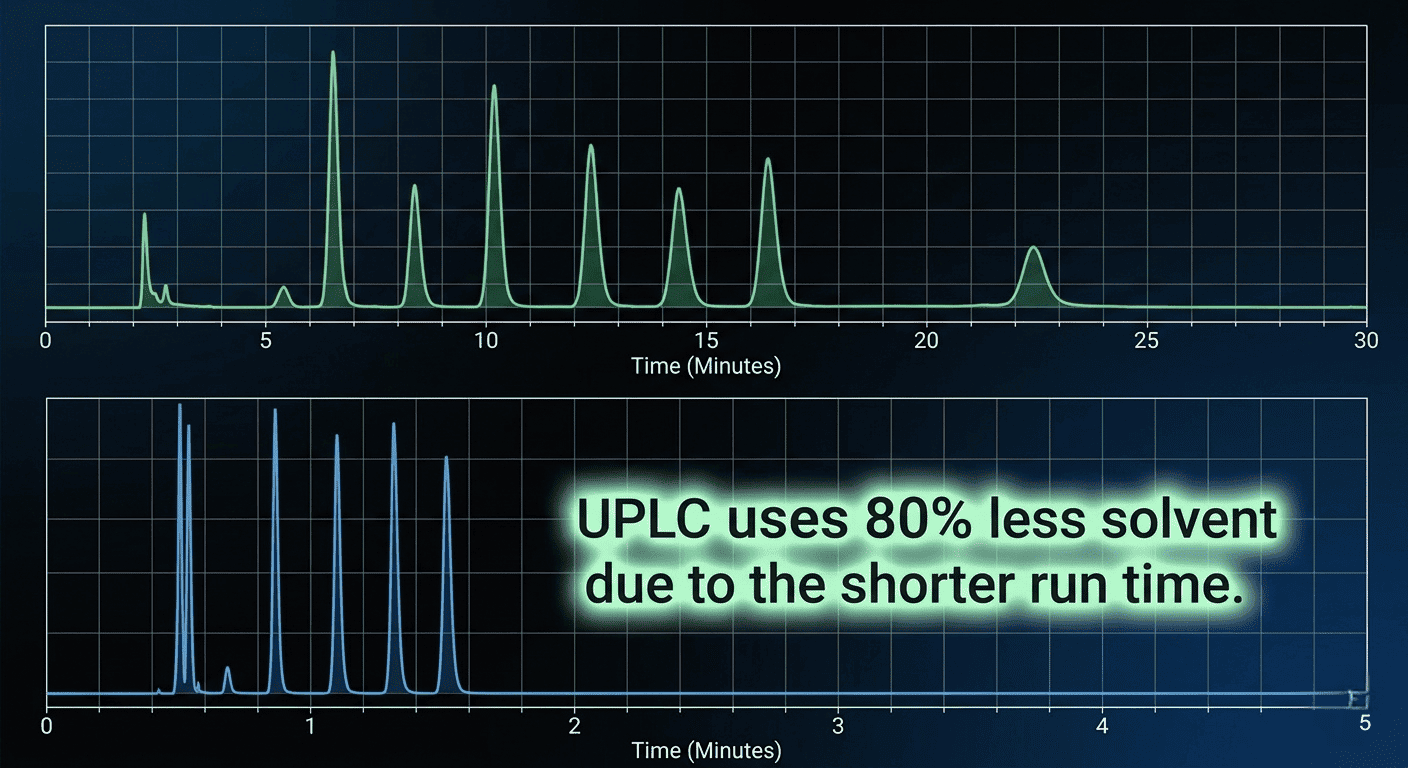
Speed & Throughput: I’ve seen 30-minute HPLC methods compressed into 3-minute UPLC runs. In a high-volume environment, this translates to processing 10x more samples in a single shift.
Sensitivity & Resolution: Because the peaks are narrower, they are also taller. This "peak sharpening" improves the signal-to-noise ratio, allowing you to detect trace impurities that HPLC might miss entirely.
Stacked chromatogram showing 30-min HPLC vs. 4-min UPLC peaks
The "Green" Factor: Smaller columns (2.1mm ID vs 4.6mm ID) mean lower flow rates. Moving from 1.5mL/min to 0.3mL/min saves a staggering amount of solvent over a year. In 2026, reducing solvent waste is as much about cost as it is about regulatory compliance.
3. Method Migration: The Scaling Logic3
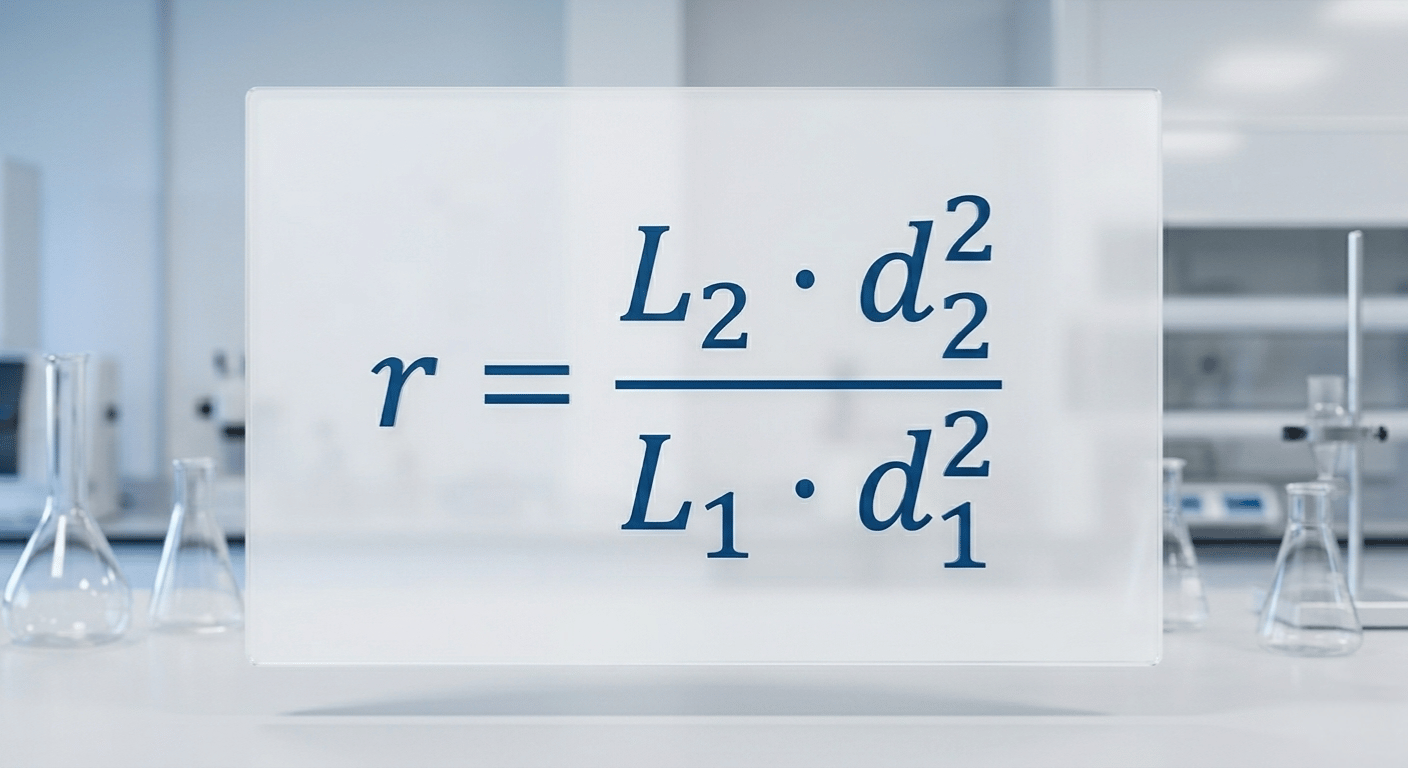
You can't just take an HPLC method and "crank up the flow." To successfully navigate hplc vs uhplc method transfer, you must scale your parameters geometrically. In my practice, we always start with the Linear Velocity.
To keep your separation consistent, use this scaling ratio (r):
(Where L is column length and d is internal diameter.)
When moving to a UPLC column (e.g., 100 x 2.1 mm from a 250 x 4.6 mm HPLC column), you will typically find your injection volume needs to drop from 10 µL to roughly 1–2 µL to prevent column overload.
4. The "Dirty" Little Secret: Sample Prep
Here is where the "Expert" advice kicks in: UPLC is a diva. While your HPLC might tolerate a "quick and dirty" sample filtration, UPLC will not. With 1.7 µm particles, the frits are incredibly fine. If you do not switch your filtration protocol from 0.45 µm to 0.2 µm or finer, you will see your backpressure skyrocket within ten injections.
5. The Financial Duel: Initial Investment vs. Lifetime ROI
When people talk about uplc advantages over hplc, they often lead with "it’s faster." But speed has a price tag.
The Upfront "Sticker Shock": A high-tier UPLC system typically commands a 30% to 50% premium over a standard HPLC. You aren't just paying for the pump; you’re paying for the low-dispersion injectors, high-speed detectors (capable of 250 Hz), and the specialized software required to handle data rates that would crash an older PC.
The Solvent Revolution: This is where UPLC pays for itself. In a 2026 "Green Lab" environment, solvent disposal is often more expensive than the solvent itself. Because UPLC uses columns with smaller internal diameters (2.1 mm), we often drop flow rates from 1.5 mL/min down to 0.3 mL/min. Over a year of 24/7 operation, that’s an 80% reduction in solvent costs and waste disposal.
Throughput ROI: If your lab is a bottleneck for production, the ability to run 100 samples in the time it used to take for 10 is an astronomical ROI. However, if your lab only runs 5 samples a day, a UPLC is like buying a Ferrari to drive to the mailbox.
6. The Maintenance "Tax": Living at 15,000 psi
In the hplc vs uhplc debate, nobody mentions the wear and tear. Living at the edge of physical limits means things break differently.
Seal and Valve Life: In a standard HPLC, your pump seals might last a year. In a UPLC running at 12,000 psi, those seals are under immense mechanical stress. Expect to perform preventive maintenance twice as often.
Column Fouling: An HPLC column is a robust beast; it can handle a little "junk" in the sample. A UPLC column, with its tiny frits, is essentially a very expensive filter. If your sample preparation isn't pristine, you’ll find yourself with a "pressure shutdown" by lunchtime.
Operator Skill: You can’t just "wing it" with UPLC. Minor errors in tubing connections (introducing even 5 µL of dead volume) will completely destroy the resolution gains of your sub-2 micron particles.
7. The "Hybrid" Middle Ground: Core-Shell Technology
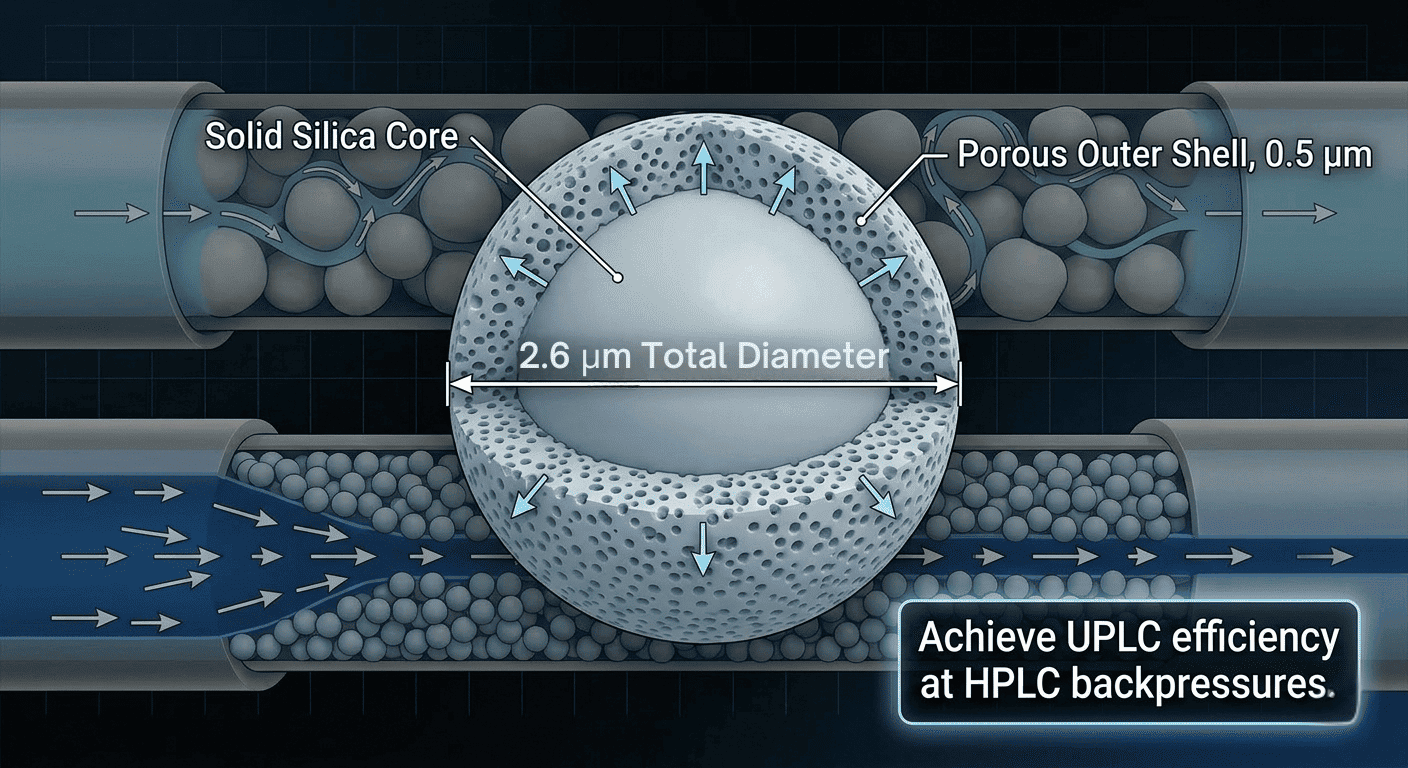
If you aren't ready to drop $100k on a new system but want the uplc advantages over hplc, there is a "cheat code" we use in the lab: Core-Shell (Superficially Porous) Particles.
Diagram of a single 2.6 µm core-shell particle architecture
By using a 2.6 µm core-shell particle, you can achieve nearly the same efficiency as a 1.7 µm UPLC particle, but at much lower backpressures. This allows you to run "UPLC-like" methods on your existing HPLC hardware. It’s the perfect bridge for labs that are slowly transitioning their infrastructure.
8. System Compatibility: Can you "Cross the Streams"?
A common question I get is: "Can I run my old HPLC methods on my new UPLC?"
The answer is Yes, but with a caveat. While UPLC systems are backward compatible, you have to account for the Dwell Volume (the volume from the point of solvent mixing to the head of the column).
UPLC systems have tiny dwell volumes (less than 100 µL). If you run an HPLC method designed for a system with a 1,000 µL dwell volume, your retention times will shift significantly. You’ll need to add a "pre-injection delay" or adjust the gradient start to match the old system's profile.
Conclusion: Making the Call for 2026
The hplc vs uplc choice isn't about which technology is "better"—it's about which one fits your specific workflow.
Stick with HPLC if: You are in a regulated QC environment with validated pharmacopeial methods that aren't easy to change, or if your samples are "dirty" (environmental/food waste) and you need robustness over speed.
Upgrade to UPLC if: You are in R&D, Metabolomics, or high-throughput Pharma. The sensitivity, resolution, and solvent savings are simply too great to ignore in a modern competitive landscape.
Still unsure which path is right for your specific application? I’ve helped countless labs audit their current methods and decide whether a hardware upgrade or a consumable optimization (like switching to specialized vials or core-shell columns) is the better move. Don't let a salesperson talk you into a "Ferrari" if you need a "Tractor."
Let's discuss your lab’s specific needs today. Reach out for a technical consultation:

 English
 Chinese