What is TOC? A Lab Expert’s Guide to Total Organic Carbon (2026)
News
Home > Faq
categories
INQUERY

Mastering Total Organic Carbon (TOC): A Lab Expert’s Perspective on Purity and Precision

Mar. 11th, 2026

In the modern laboratory, we often say that "clear water isn't always pure water." You might have a system showing perfect resistivity at 18.2 MΩ·cm, yet your HPLC baseline is drifting, or your bacterial endotoxin tests are failing. This is where Total Organic Carbon (TOC) comes in. As an analytical parameter, TOC is the true gatekeeper of water quality, revealing the hidden organic molecules that traditional sensors miss.

What is TOC and Why Does it Matter in 2026?

So, what is TOC? At its core, Total Organic Carbon represents the concentration of carbon derived from organic compounds in a sample. While inorganic carbon (TIC) like carbonates is relatively harmless in many processes, TOC organic matter is a food source for bacteria and a catalyst for chemical interference.

In 2026, the stakes are higher than ever. Whether you are in semiconductor fabrication—where a single organic film can ruin a wafer—or in the pharmaceutical industry following USP <643> standards, monitoring TOC is no longer optional. It is a critical early-warning system for your facility.


The Analytical Toolkit: TC, TIC, and NPOC

When we sit down at the bench to analyze a sample, we don't just look for "carbon." We break it down to understand the matrix.

  • TC (Total Carbon): The sum of all carbon in the sample.

  • TIC (Total Inorganic Carbon): Dissolved CO2, bicarbonates, and carbonates.

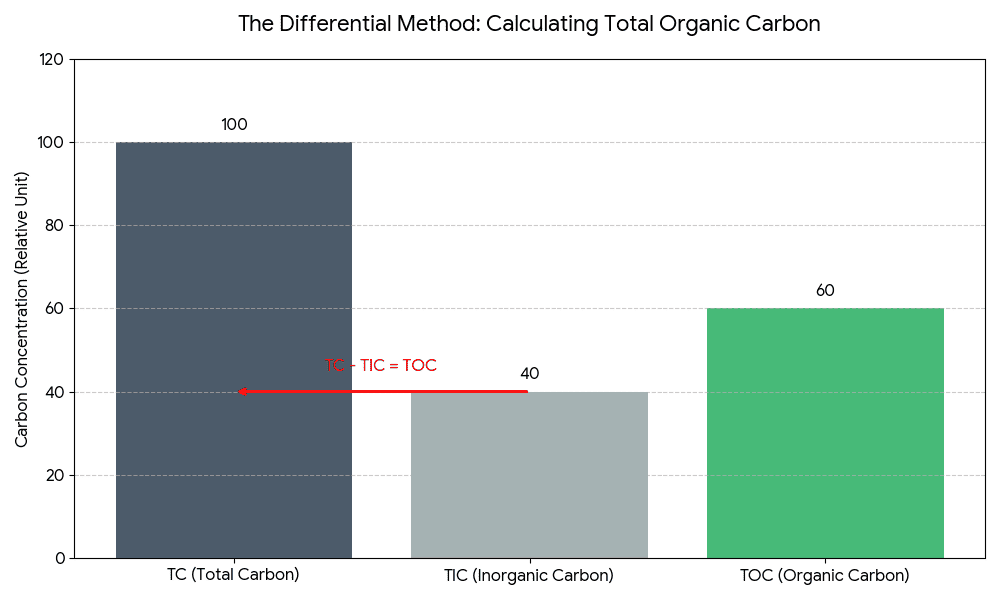
  • TOC Organic: Calculated as TC - TIC.

In most high-purity applications, we utilize the NPOC (Non-Purgeable Organic Carbon) method. We acidify the sample to a pH of 2 or less and purge it with nitrogen. This "blows off" the inorganic carbon, leaving only the organic molecules for oxidation. This is the most robust way to ensure your data reflects true organic contamination.

 See the "Differential Method" chart below to understand the relationship between TC, TIC, and the resulting TOC value.

the relationship between TC, TIC, and the resulting TOC value

Choosing the Right Oxidation Method: My Experience

In my years in the lab, I’ve seen many teams struggle because they chose the wrong instrument for their matrix. Here is the reality of the two dominant technologies:

1. High-Temperature Catalytic Oxidation (HTCO)

This is the "workhorse" for wastewater and environmental samples. It combusts everything at 680°C to 1000°C.

  • The Pro: It breaks down complex, high-molecular-weight organics that UV might miss.

  • The Con: If you are running high-salt samples, the catalyst will clog. I’ve spent countless hours replacing quartz tubes because the matrix was too "dirty."

2. UV/Persulfate Oxidation

The "Gold Standard" for the pharmaceutical and semiconductor industries. It uses UV light and chemical oxidants to generate hydroxyl radicals.

  • The Pro: Incredible sensitivity. We can detect levels down to the single-digit ppb (parts per billion) range.

  • The Con: Not suitable for samples with high particulate matter or turbidity.

Expert Tip: If you are seeing inconsistent spikes in your ultrapure water loop, it’s often not the water—it’s the sampling technique. Plastic leachables from cheap vials can easily add 50 ppb to your result.

If you're unsure which technology fits your specific SOP, feel free to message me directly on WhatsApp: 86 18338832256 or shoot an email to boonemi@aijirenvial.com for a technical consultation.


Real-Time Monitoring: Stopping the "Spike"

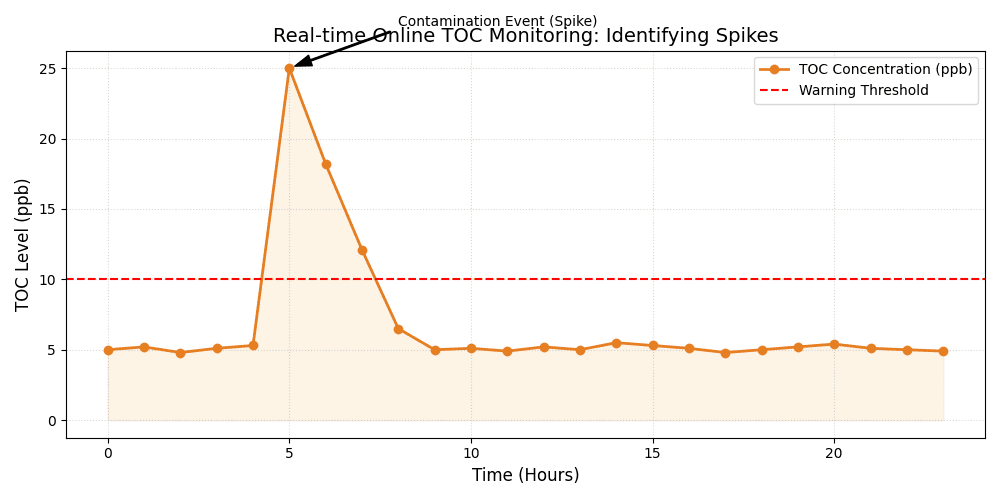
One of the biggest shifts we've seen in recent years is the move from lab-based testing to Online TOC Monitoring. Waiting for a lab report means you are looking at the past. If a carbon spike happens during a cleaning-in-place (CIP) cycle, you need to know now.

real time online toc monitoring identifying spikes

As shown in the graph above, a sudden TOC spike (often caused by a pump seal failure or a compromised filter) can be caught instantly by online sensors, allowing you to divert the water before it contaminates your entire production line.


Final Recommendations for Lab Managers

  1. System Blanks are Non-Negotiable: Your reagents often contain more carbon than your ultrapure water. Always run a system blank to subtract the background noise.

  2. Validate Your Vials: Use certified low-TOC vials. Saving a few cents on consumables can cost you thousands in failed batch validations.

  3. Stay Compliant: Ensure your analyzer meets the "System Suitability" requirements of your specific Pharmacopeia (USP, EP, or JP).

Total organic carbon analysis is the heartbeat of your quality control. It’s about more than just a number on a screen; it’s about the integrity of your final product.

Connect With Our Specialists

Are you looking to optimize your TOC monitoring or need advice on the best consumables for your analyzer? We are here to help you translate complex data into practical solutions.


References & Further Reading

Inquiry