Mar. 11th, 2026
Introduction: The "Fingerprint" of Chemistry
In the modern analytical lab, we don't just "guess" what's in a sample; we need certainty. When clients ask about mass spectrometry or mass spectroscopy, they are looking for the ultimate "chemical scale." While the term mass spectroscopy is still found in older texts, in our daily lab practice, the scientific community discourages its use to avoid confusion with light-based spectroscopy. We are measuring mass, not light.
By coupling separation techniques with a mass spectrometer, we gain the power to identify and quantify molecules in complex mixtures with incredible precision. This is where mass chromatography truly shines.
What is Mass Spectrometry? (Beyond the Textbook Definition)
Whenever a junior analyst joins my team and asks, "what is mass spectrometry?" I don't just give them a formal mass spectrometry definition. I tell them it's a technique for creating ions, sorting them, and measuring them based on their weight.
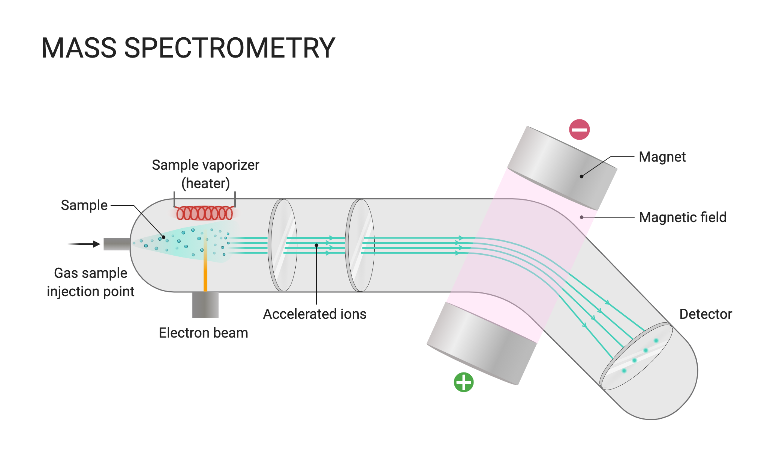
Specifically, it measures the mass-to-charge ratio (m/z) of molecules. In practice, what DOES a mass spectrometer do? It takes your sample, blasts it into gas-phase ions, uses magnetic or electric fields to separate those ions by m/z, and the detector counts them to create a mass spectrum. Think of it as a high-speed, dynamic sorting machine for individual molecules.
How Does Mass Spectrometry Work? The Three Essential Stages
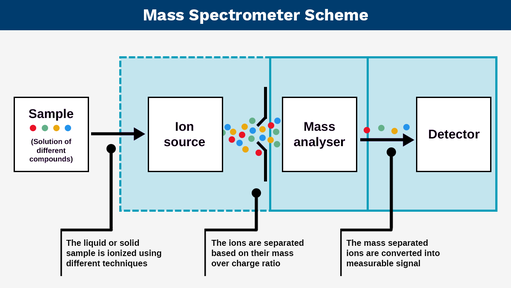
If you are trying to understand how does mass spectrometry work, it always comes down to these three stages in the hardware:
-
The Ion Source (The "Spark"): This stage converts the sample into ions. In our lab, we use "hard" ionization like Electron Ionization (EI) for GC, or "soft" ionization like Electrospray Ionization (ESI) for large clinical biomolecules.
-
The Mass Analyzer (The "Race"): The analyzer uses fields to deflect ions. Just like a tight corner on a racetrack, lighter ions deflect more easily than heavy ones. This is the core of what a mass spectrometer does—separating ions by their m/z.
-
The Ion Detector (The "Count"): The detector records the number of ions hitting it at specific m/z values.
The Practical Application: Gas Chromatography-Mass Spectrometry (GC-MS)
In real-world diagnostics, the real magic happens when we couple MS with a separation tool like a gas chromatograph. This hyphenated technique is known as gc ms (or gas chromatography-mass spectrometry).
The GC separates the complex mixture chronologically, and the MS provides the "fingerprint" identity of each separated compound as it elutes. If you are searching for whats mass spectrometry useful for? This is it—solving complex mixtures.

Comparison: Choosing Between GC-MS and LC-MS
The answer to "which one do I need?" depends entirely on your sample’s chemistry:
| Feature |
GC-MS (Gas Chromatography-MS) |
LC-MS (Liquid Chromatography-MS) |
| Mobile Phase |
Inert Gas (e.g., Helium, Nitrogen) |
Liquid Solvents (Water, Methanol, etc.) |
| Sample Req. |
Must be Volatile & Thermally Stable |
Suitable for Polar, Large, Non-volatile |
| Common Ionization |
Electron Ionization (EI) - "Hard" |
Electrospray (ESI) - "Soft" |
| Typical Apps |
Pesticides, Fragrances, VOCs |
Proteins, Biopharma, Blood Analysis |
| Advantage |
Standardized spectra for library searches |
Broader range for non-volatiles |
Applications: What is a Mass Spectrometer Used For?
The applications of mass spectrometry touch almost every industry:
-
Clinical Diagnostics: Identifying metabolic diseases via protein biomarkers.
-
Pharmaceuticals: Crucial for drug discovery and metabolite screening.
-
Environmental Analysis: Testing water or soil for trace pollutants.
-
Forensics: Identifying explosive residues or confirming drug abuse.
Expert Tip: For reliable gc ms results, sample preparation is 90% of the battle. If you're struggling with high background noise, optimize your derivatization process or GC column selection.

Need Expert Guidance on Mass Chromatography?
Choosing the right gas chromatography-mass spectrometry setup or interpreting a complex mass spec chart can be daunting. If you have specific questions about m/z interpretations or need advice on the best consumables, feel free to reach out directly.
References
-
Sparkman, O. David (2000). Mass spectrometry desk reference. Pittsburgh: Global View Pub. ISBN 978-0-9660813-2-9.
-
Downard K (2004). Mass Spectrometry - A Foundation Course. Royal Society of Chemistry.
doi:10.1039/9781847551306
.
-
Fenn JB, et al. (1989). "Electrospray ionization for mass spectrometry of large biomolecules." Science, 246(4926): 64–71.
doi:10.1126/science.2675315
.
-
Schwartz JC, et al. (2002). "A two-dimensional quadrupole ion trap mass spectrometer." Journal of the American Society for Mass Spectrometry, 13(6): 659–69.
doi:10.1016/S1044-0305(02)00384-7
.
-
Hu Q, et al. (2005). "The Orbitrap: a new mass spectrometer." Journal of Mass Spectrometry, 40(4): 430–43.
doi:10.1002/jms.856
.
-
Aisporna A, et al. (2025). "Adaptive Modeling of Tandem Mass Spectrometry Data: Creation of the METLIN 960K MRM Database." Analytical Chemistry, 97(44): 24586–24595.
doi:10.1021/acs.analchem.5c04639
.
-
Eiceman, G.A. (2000). Gas Chromatography. Encyclopedia of Analytical Chemistry. Wiley. ISBN 0-471-97670-9.
-
Verbeck GF, et al. (2002). "A fundamental introduction to ion mobility mass spectrometry applied to the analysis of biomolecules." Journal of Biomolecular Techniques, 13(2): 56–61.
PMC2279851
.
-
Tanaka K, et al. (1988). "Protein and Polymer Analyses up to m/z 100 000 by Laser Ionization Time-of-flight Mass Spectrometry." Rapid Commun Mass Spectrom, 2(20): 151–3.
doi:10.1002/rcm.1290020802
.
-
Maher S, et al. (2015). "100 years of mass spectrometry: Perspectives and future trends." Rev. Mod. Phys., 87(1): 113–135.
doi:10.1103/RevModPhys.87.113
.

 English
 Chinese